
Enclosure material selection is usually a trade between weight, cost, corrosion resistance and thermal performance. Here is how we guide customers through the decision on machining projects.
Aluminum (6061, 5052, 6063)
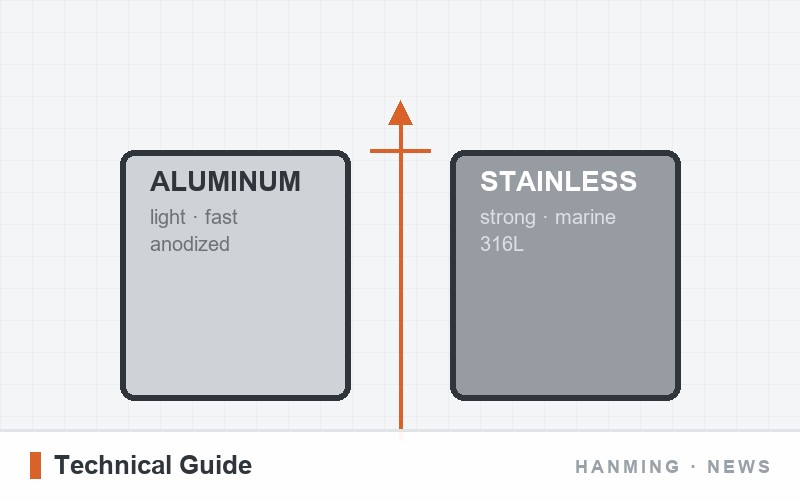
Lightweight, fast to machine, easy to anodize, and roughly two to three times more thermally conductive than stainless steel. It is the default for heat-dissipating enclosures, drone and robotics structures, and anything where mass matters. 6061-T6 is our most common enclosure material — it machines cleanly and anodizes uniformly.
Stainless steel (304, 316L)
Heavier and slower to cut, but far more corrosion resistant and stronger per unit volume. 304 suits general industrial and food-contact environments; 316L adds chloride resistance for marine, chemical and medical exposure. Stainless work-hardens quickly, so tooling and feeds need to be planned — something we handle in CAM programming.
The practical rule
Choose aluminum when weight, heat dissipation or machining budget dominate. Choose stainless when the part lives in a corrosive, hygienic or high-strength environment. And if you are torn: machine the body in aluminum with stainless fasteners and inserts — a combination we build regularly.